
Intensive. Extensive. Pumpstations. Drip. Pivots. Micros. What on earth is going on?
Lets break this down.
At the most basic level, irrigation is the process of applying water from a given source to the root zone of a plant. This involves two main system components:
- Bulk water supply system.
- Infield system.
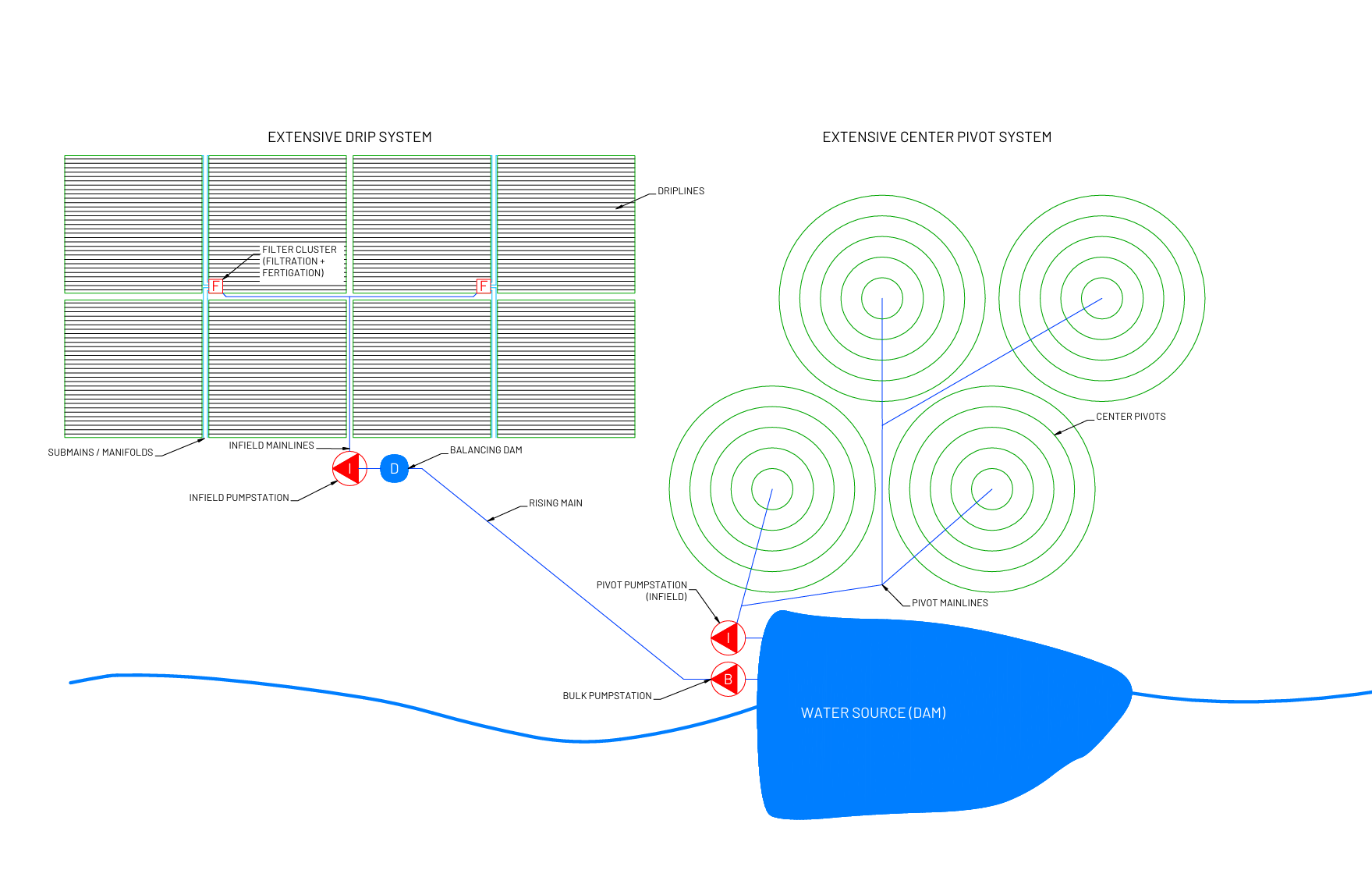
The bulk water system takes water from its natural source to close to the point of application. The typical bulk water system consists of a pumpstation, a rising main (pressure pipe) and potentially a canal (source). The pumpstation lifts water to the rough level of the irrigated fields. At this point, the water is usually either dropped into a balancing dam for use by the infield system, or dropped into a canal for conveyance to point of use.
Canals are typically used if large volumes of water need to be carried long distances, as they tend to be significantly cheaper to construct than pipelines accomplishing the same purpose. In some cases, schemes use offtake works located at weirs to channel water into a canal, resulting in no need for a pumpstation or rising main.
Once the water has arrived close to the point of application, the infield system takes over. This looks different depending on system types.
Extensive infield systems usually have a simple pumpstation that pushes water to either center pivot centers or to infield filter clusters for drip systems. Fertigation takes place at this point, as does filtration in the case of drip systems.
Beyond this point, water heads out for application to the crop, either via drippers or via pivot sprinklers.
Intensive infield systems are generally centered around the pumpstation, at which filtration and fertigation (drip) takes place. Once water heads to the field, it is passed though a secondary filter before each block to minimize clogging risk.
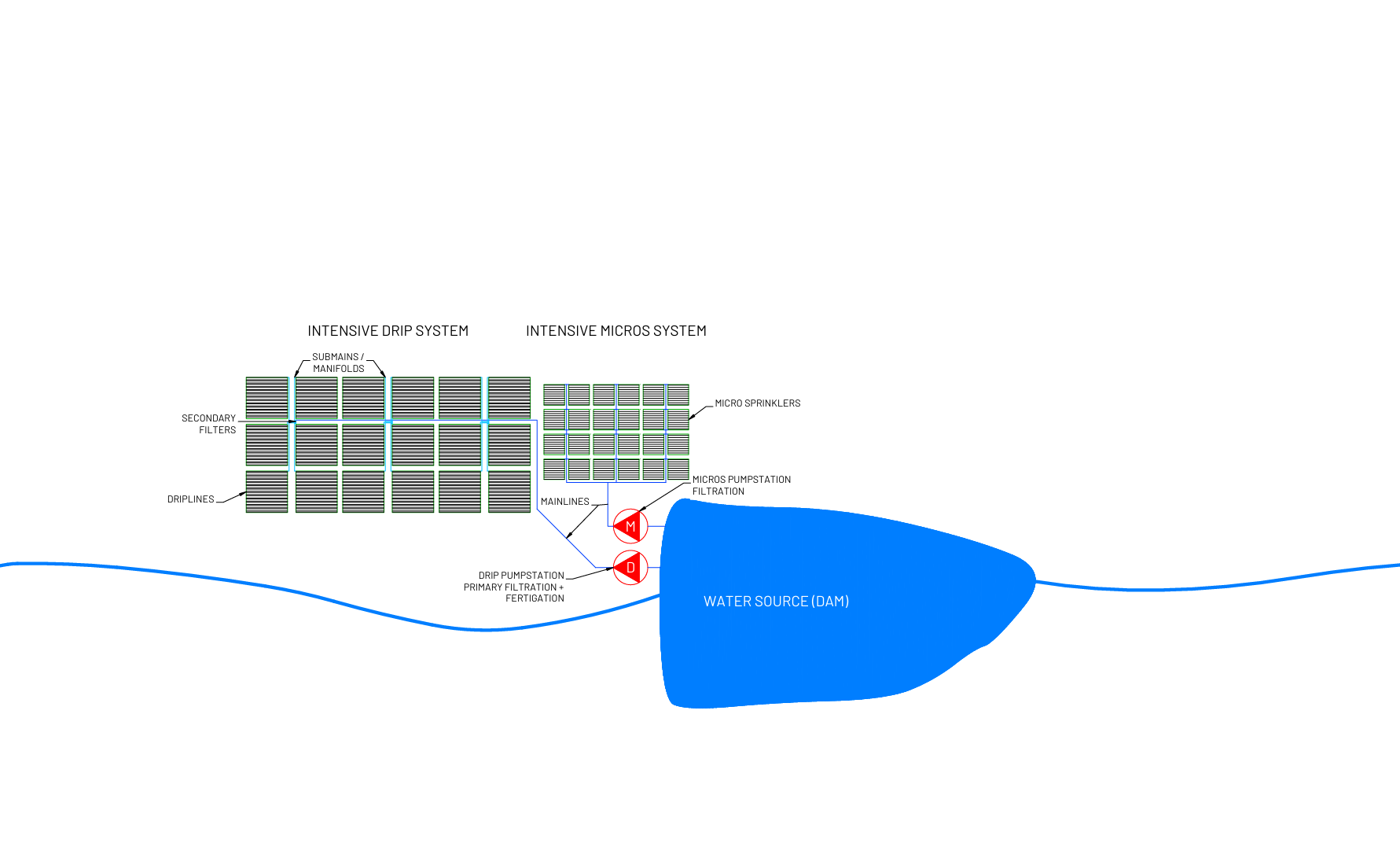
Extensive systems usually have irrigation blocks > 10 ha in size, while intensive systems can range from 0.5 to 5 ha blocks. Intensive systems are therefore more expensive to design and implement, as more infrastructure is packed into a smaller space. Of the extensive system types, center pivots are the most economical, as they cover large areas 50+ ha from a single point of water supply.
The choice of system type is very situation-specific and is dictated by soils, budget, farmer preferences and management capability. Further information on intensive and extensive systems can be found here and here.